

Keeping Score
Our scorecard tracks Canada’s progress on key economic, social, and environmental indicators over the next decade. All metrics are internationally accepted indicators of a country’s economic, social and environmental progress.
2026 SCORECARD REPORT - EXECUTIVE SUMMARY
Time to Execute: Canada’s Crucible Moment
The findings of this year’s Scorecard are a stark wake-up call for the nation.
As we reflect on 2025—a year defined by geopolitical rupture and domestic economic strain—the message is clear: It is time to execute. The fragility of our economic growth is no longer a theoretical concern; it is a reality felt by households at the grocery store and the gas pump. Our young people face a tough job market, with the youth unemployment rate remaining roughly double the overall rate.
Geopolitics now poses an existential threat to our way of life. Canadians must learn, in real time, how to compete in an increasingly protectionist world. The good news is that we possess everything necessary to succeed: a wealth of natural resources, a clean energy grid, and a highly educated populace. Furthermore, we are not the only G7 country facing these geopolitical pressures. While this generalized uncertainty creates headwinds for global demand, it also opens huge opportunities for both governments and businesses to capitalize on, as long as we act with urgency to address the persistent barriers and bottlenecks that have pushed our economy off track.
Our metrics reveal a central vulnerability: a dire lack of investment, which begets weak productivity. This is the root cause of our stagnant wages and falling per capita incomes relative to our G7 peers. If we fail to address the productivity conundrum by creating an environment conducive to private-sector investment, we risk locking ourselves into a cycle of decline that will undermine our social safety nets. By contrast, resolving it would boost foreign investment and reduce the number of companies tempted to relocate from Canada to the U.S. The priority must be leveraging our natural strengths—especially in agriculture, energy, and critical minerals—while rapidly adopting nascent technologies like AI to reclaim our competitive edge. To do this requires building new relationships with our trading partners.
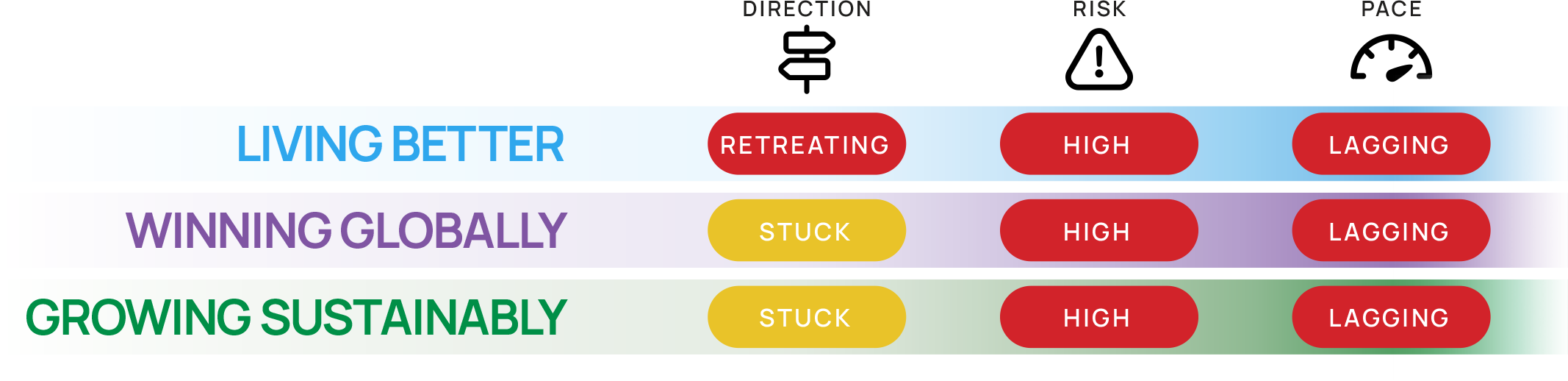
Key findings

Low business investment
Non-residential private-sector investment as a share of nominal GDP has dropped to its lowest level since the 1950s.
Widening poverty gap
The poverty rate has rebounded to 10.9%, and the average poverty gap widened to 33% in 2023.
Per capita rebound
Real GDP per capita increased by 0.5% in the third quarter of 2025, marking a positive shift after years of decline.

Sharp drop in population growth
Canada saw a quarterly population decline of 0.2% in late 2025, the largest outside the pandemic era since the 1940s.


Narwhal count
Canada now has 28 Narwhal companies (startups worth USD $1B+), surpassing the Coalition's 2030 goal of 17.
Youth NEET rate
12% of Canadian youth aged 15-29 are not in employment, education, or training, with a rate as high as 41% in Nunavut.
Read the Scorecard in detail
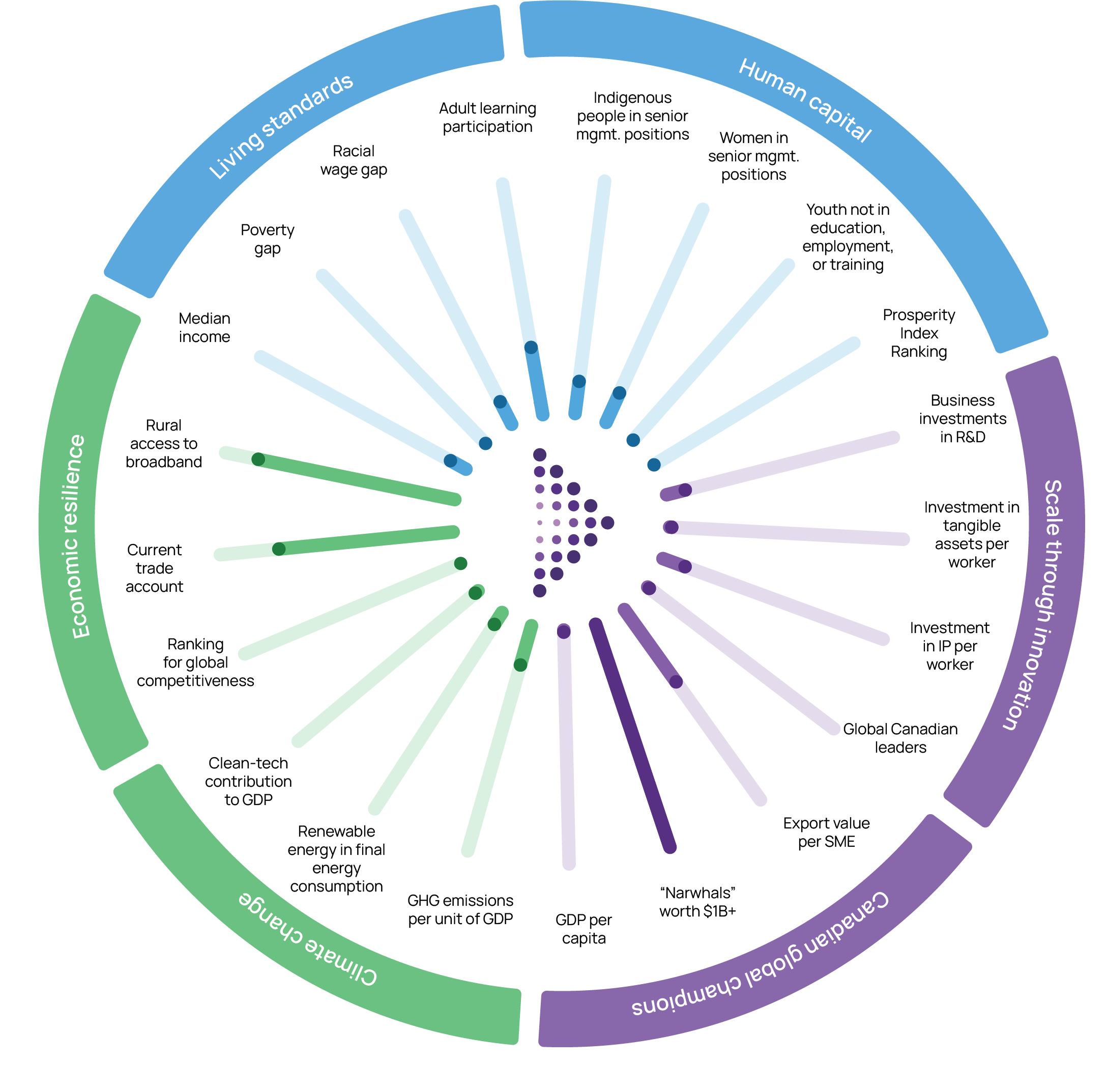
The Coalition for a Better Future produces a scorecard of 21 internationally-recognized metrics to track Canada’s economic and social progress.
For each metric contained in the scorecard, an aspirational target has been set for 2030. Each year, the Coalition will update Canada’s progress toward each metric.
While short-term variations may or may not be meaningful, trends over longer periods don’t lie. Our intent is to set ambitious but achievable long-term targets for our country.
We believe aspiring to meet the scorecard’s ambitious 2030 targets will lead to improving Canadians’ lives.
Living Better
The living better pillar is about key drivers that will boost living standards. The aim is to promote policies and practices that will lead to better lives for all of us, partly by building the world’s smartest, most-diverse and best-connected workforce.
Winning Globally
A second key pillar in our scorecard is the extent to which our companies are achieving global scale through innovation and sustained investment, and how well we are doing in creating Canadian-grown global champions.
Growing Sustainably
The environment is one of the key pillars we must have at the forefront of decision making. A greener economy will enhance our economic competitiveness.