

Winning Globally
Direction: Stuck
Risk: High
Pace: Lagging
This pillar focuses on the extent to which our companies are achieving global scale through innovation and sustained investment.
We also assess how well we are doing in creating Canadian-grown global champions.
The importance of putting investment at the forefront of our economic policy debate is something we’ve tried to draw attention to since the Coalition launched in 2021. Canada’s
productivity crisis—which is manifesting in falling per capita income levels—is fundamentally an investment crisis. And just about every metric for private sector investment looks terrible.
Growth at a glance
Aspirational targets have been set across the three pillars to attain long term, inclusive and sustainable growth.
GDP per capita ($)
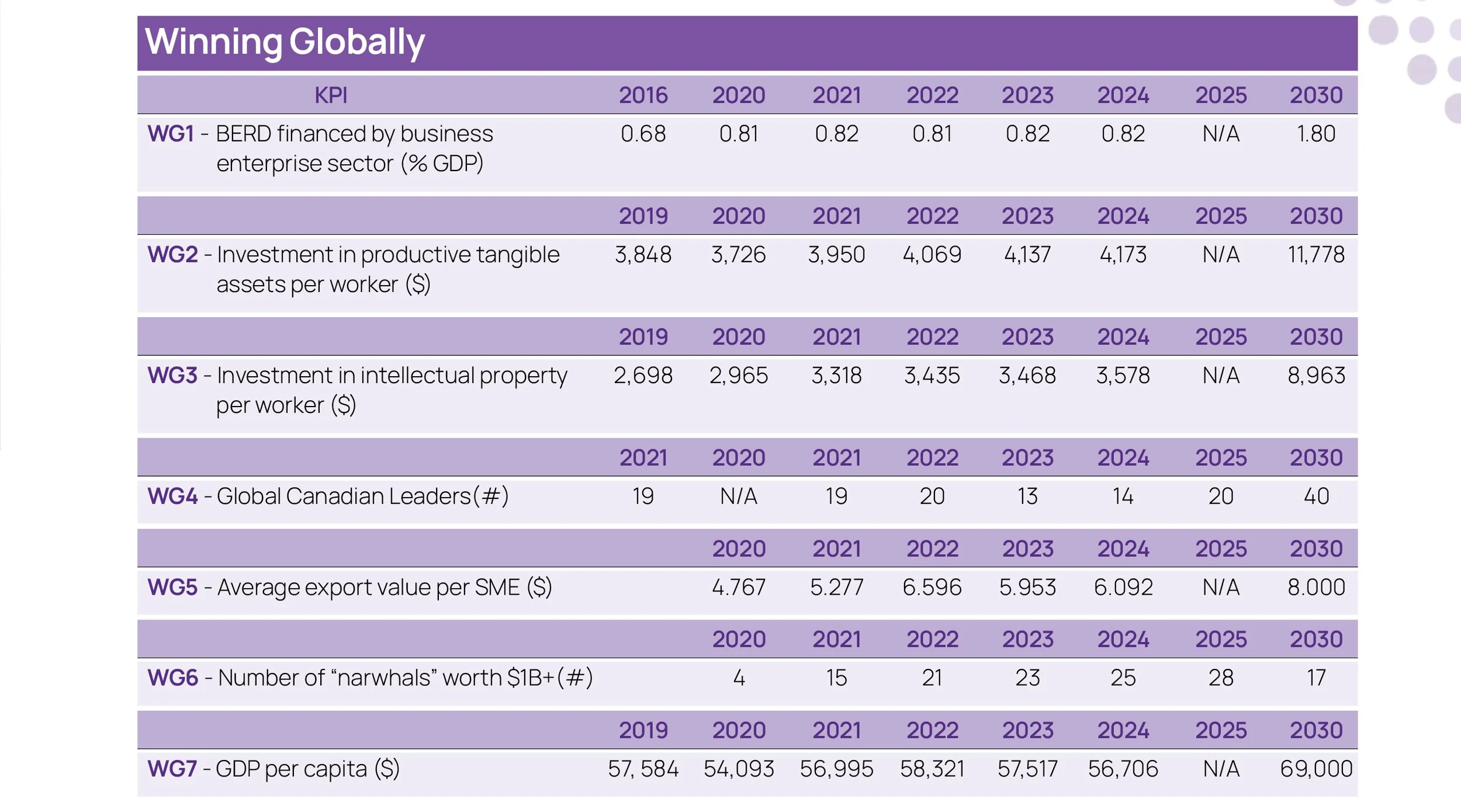
Canada’s GDP per capita was $60,165 in Q3 2025. Growth of GDP per capita in Canada has underperformed most of its G7 peers since 2010.
Investment in Canada’s resource sector has stalled since 2014, with no other sector filling the gap. Consequently, Canadian GDP per capita is now just 75% of the U.S. level, down from 90% in 2010. Median wages in Canada trail those in the U.S. by $7 per hour, even after adjusting for purchasing power. According to 2024 OECD data, Canada ranked 18th among 38 countries in GDP per hour worked, a key productivity indicator.
Reversing this “death knell” requires a commitment to execution. Budget 2025 aims to enable $1 trillion in total investments over five ears, with economists estimating that $500 billion in additional private investment could lift real GDP by 3.5% by 2030. This would translate to a $1,400 annual increase in purchasing power for every Canadian. While challenges remain, the investment environment is showing signs of a rebound. Fidelity recently noted positive policy developments such as the focus on increasing investment spending and productivity are finally starting to lessen the headwinds restraining the economy. The rebound in real GDP growth and declining unemployment bears this out.
Everything now depends on the effective execution of those same policies—which involves risk and will take time—but planned fiscal spending and greater interprovincial cooperation is expected to continue the positive trend.
Scale Through Innovation
Business investments in R&D (% GDP)
The link between Canada’s productivity crisis and its investment crisis is now absolute. For years, the Coalition has warned that our economic foundation was thinning; in 2026, we have turned the corner into critical territory. Canadian workers receive approximately 55 cents of new capital investment for every $1 received by their U.S. counterparts. The gap is even wider in the “tools” of the future: We receive only 41 cents on the dollar for machinery and equipment (M&E) and a dismal 32 cents for intellectual property (IP) products like software and R&D.
This investment disparity is a homemade problem. Over the past decade, Canada has seen massive investment shifts away from productive exports toward domestic-facing, low-productivity sectors like residential construction.
Investment in productive tangible assets per worker ($)
Although Canada’s M&E investment increased slightly in 2024 compared to 2023, the country still lags behind all G7 countries except the U.K. as of 2023. Since 2016, the overall trend shows little progress toward meeting the Coalition’s 2030 investment goal.
Investment in intellectual property per worker ($)
Although Canada had a slight increase in IP investment in 2024 compared to 2023, it lags behind all G7 countries except Italy as of 2023. Since 2016, the overall trend has shown little progress toward achieving the 2030 investment goal.
Canadian Global Champions
Global Canadian leaders (#)
Analysis from the Narwhal Project reveals a nuanced “Unicorn problem.” While Canada is excellent at starting and scaling firms—often outscoring the U.S. in patent filings per firm in health-tech and clean-tech—it fails at the finish line. Since 2020, the U.S. has seen 738 unicorn exits; Canada has seen only two.
This lack of “exit” scaling often results in promising firms being acquired by foreign competitors before they can become global champions.
Today, the number of Canadian-grown global champions stands at 20—including Royal Bank, Shopify, and Agnico Eagle—but this is still well shy of the national target of 40. While Canada ranks 17th in the Global Innovation Index—its “knowledge creation” is among the best in the world—it continues to fail in the deployment and commercialization of that knowledge.
Average export value per SME ($)
While Canada struggles with aggregate investment, its tech startup environment remains a distinct bright spot. The country now boasts 28 “Narwhals”—privately held startups valued at over $1 billion USD—up from just three in 2020.
This is the only Coalition target Canada has surpassed ahead of schedule.
Number of “narwhals” worth $1B+(#)
The average value of SME exports has increased slightly since 2023.
Related Insights