
Canadians hopeful, but sense of urgency is high on need to learn new skills

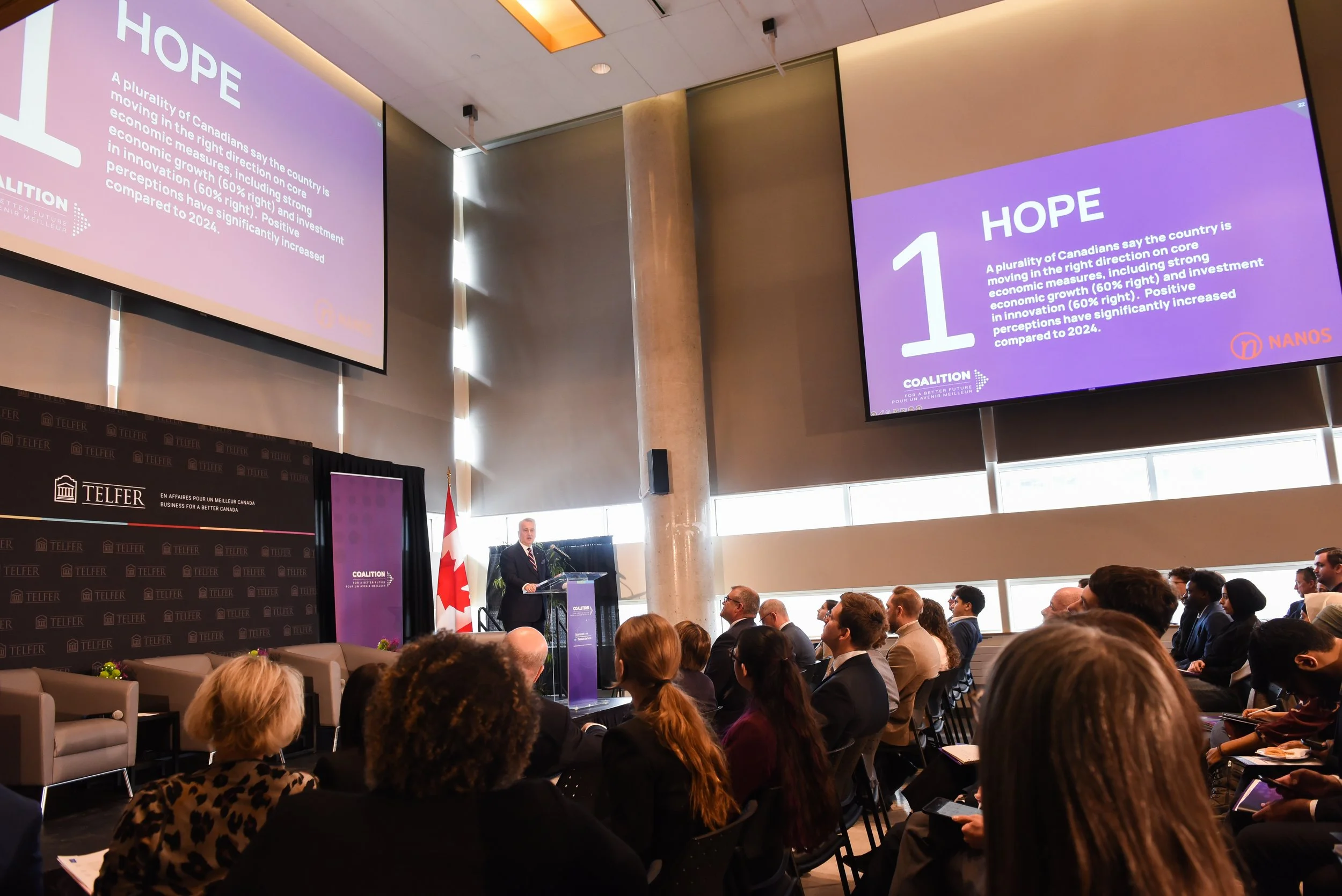
Chief Data Scientist Nik Nanos, Nanos Research presents at the Coalition For a Better Future’s Scorecard Reporting Event March 26. | PHOTO: Melanie Shields
Canadians feel a mix of hope and anxiety about the country’s economic direction.
That is the overarching finding of a new national survey conducted by Nanos Research for the Coalition for a Better Future.
During the annual Scorecard Reporting Event on March 26, Nik Nanos, Chief Data Scientist at Nanos Research, said the findings are encouraging. But, he emphasized that they should not be confused with satisfaction. Canadians are eager to see the specific details of the proposed economic plans before fully committing to this optimism.
“We kind of like what we're hearing, but we need to see what actually transpires in terms of the real impact on economic growth and investment in innovation,” Nanos told the audience.
He said his latest polling showed that 60 per cent of Canadians say the country is moving in the right direction on core economic measures, including strong economic growth. And a similar percentage says the country is moving in the right direction when it comes to investment in innovation.
The positive perceptions have significantly increased since 2024, said Nanos.
“The good news is ... that there is a brighter view on where we are on some of the economic measures compared to the past,” he told the audience.
“We kind of like what we're hearing, but we need to see what actually transpires in terms of the real impact on economic growth and investment in innovation,”
Nik Nanos, Chief Data Scientist, Nanos Research
At the same time, Nanos said, Canadians’ willingness to adjust to today’s changes is unclear.
While Canadians are expressing hope, there is a high level of urgency about the disruptions to their lives caused by AI, with a striking 80 per cent of those polled saying it’s urgent to learn new skills. But Canadians have “mixed emotions” in response to the underlying skills emergency. About 62 per cent are open or somewhat open to learning a new work skill, but 31 per cent say it is not applicable or that they are retired.
“I think it is quite striking that eight out of every 10 Canadians rate the importance of learning new skills as urgent, not something that's nice to have, not something that you know is planned, but that there is a certain level of urgency,” said Nanos.
Similarly, despite concerns about job security, people don’t seem as willing to consider uprooting themselves and moving for work as in the past. Nanos’ polling finds 47 per cent of respondents say they are unwilling to move for work. And this is more pronounced among young Canadians (aged 18-34), with over half saying they are not inclined to pull up stakes and move for a job.
“This is really contrary to the pre-COVID world, when there was a lot more mobility,” Nanos remarked.
He said the reluctance to relocate may have to do with people’s lack of confidence in the security of any new job and the advent of telework, noting that this is a “significant signal for employers and the workforce of the future.”
The jury is still out on whether Canada is now moving in the right direction on climate change, he reported. Of the issues measured in recent polling, this is the only area that did not show a more positive perception of how the country is doing, Nanos said. He found that 35 per cent say the country is moving in the right direction, while 38 per cent say it is moving in the wrong direction and 27 per cent are unsure.
Skepticism is higher among young people, with 42 per cent saying the country is moving in the wrong direction on addressing climate change.
Canadians are clearly wondering how efforts to promote innovation and economic growth fit with the country’s environmental aspirations, Nanos noted.
Summing up, he said: “So that’s where we’re at–hopeful, anxious with a sense of urgency.
“We’re in an era of economic disruption” caused by rapid technological and demographic shifts, and at the same time, Canada also has to deal with climate change, Nanos said.
With all that in mind, he said the Coalition’s commitment to “data, ideas and action” is more important than ever.