
Senators urged to treat transportation as strategic national asset by Coalition co-chair Raitt

Coalition co-chair Hon. Lisa Raitt testified before the Senate Committee on Transport and Communications regarding the committee's study on maintaining transport services during labour disruptions. PHOTO: Screenshot
Appearing before the Senate Standing Committee on Transport and Communications on November 26, Coalition for a Better Future Co-Chair the Honourable Lisa Raitt, delivered a clear message: Canada must rethink how it views and regulates its transportation system if it wants to remain competitive in a rapidly changing global economy.
Raitt, a former federal transport minister and current Vice-Chair of Global Investment Banking at CIBC Capital Markets, was asked to appear to discuss the maintenance of transport services in the case of labour disruptions.
Drawing on the Coalition’s work on productivity, competitiveness and long-term economic growth, Raitt highlighted that repeated supply chain disruptions adversely impact Canada’s productivity. Raitt stated that rail and marine transportation are strategic national assets essential to economic security.
“If we are serious about building an economy that is pan-Canadian in nature — competitive, connected and resilient — then we really need to modernize how we think about essential services and transportation. That means treating our transportation networks as the strategic national assets that they truly are,” said Raitt.
A national economy at risk
During her remarks, Raitt spoke about the consequences of labour stoppages and bottlenecks in critical trade corridors. When ports, rail lines or marine routes shut down, she said, the impact is no longer local or sector-specific — it is nationwide. These disruptions trigger economic shocks, weaken Canada’s productivity and harm the country’s reputation as a reliable trading partner.
Meanwhile, the United States is accelerating its own competitiveness agenda through massive investments in infrastructure, energy, advanced manufacturing and critical minerals.
“They are not just growing their economies; they are trying to capture global market share. If Canada does not adapt, we do have a risk of being left behind.”
Modernizing Canada’s transportation framework
Raitt urged senators to adopt a forward-looking approach built around resilience, clarity and confidence. Her key recommendations included:
Rethinking what counts as an “essential service”
Developing pre-emptive continuity plans for major trade corridors
Speeding up regulatory decision-making
Implementing modern dispute-resolution tools that protect bargaining while preventing prolonged work stoppages
She said Canada has the resources and potential to lead again, but only if it modernizes its framework in the national interest. Indecision, she cautioned, has real economic consequences.
“When governments delay their approvals, when regulations do not keep pace with the risk, when we fail to make decisions in real time — all of that indecision is actually a decision. It costs us investment, jobs and credibility.”
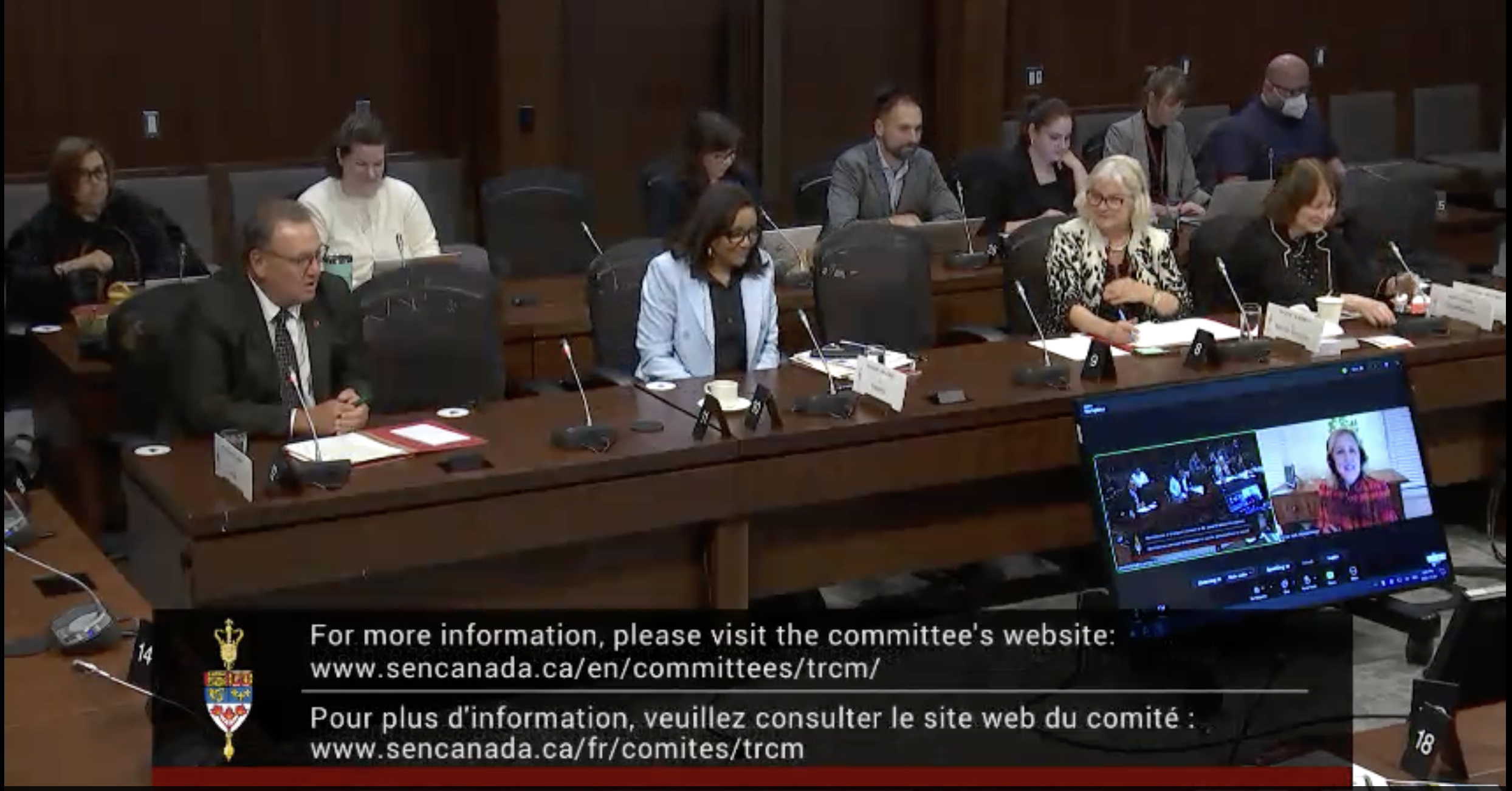
PHOTO: Screenshot
Structural reform
During questioning, senators raised concerns about the growing reliance on section 107 of the Canada Labour Code and the Canadian Industrial Relations Board’s reluctance to enforce orders.
Referring to her time as Minister of Labour, Raitt said that Section 107 was viewed as a “bridge too far” and only used to pose questions about maintenance of activities, not to stop strikes.
Raitt noted that it has more recently become a “blunt tool” for halting work stoppages and warned that overusing it could provoke wildcat or illegal strikes.
Instead, she urged senators to examine structural reforms — such as clarifying maintenance-of-activities rules and incorporating economic and security criteria into decision-making — while strengthening mediation and arbitration systems.
A call for courage
Raitt closed by reminding senators of Canada’s capacity to lead when decision makers choose to act boldly.
“We should expand, diversify and secure the markets we serve. That requires modern infrastructure, a resilient supply chain and a regulatory system calibrated for the economy we’re trying to build,” said Raitt.
“We have to be bold. We have to be willing to modernize, invest, streamline and, yes, make difficult decisions when the national interest is at stake. We know we have done big things before in this country… We can do it again; we just have to have the courage to lead.”