
Raitt sees potential in Canada’s auto sector but urges a shift toward faster project execution
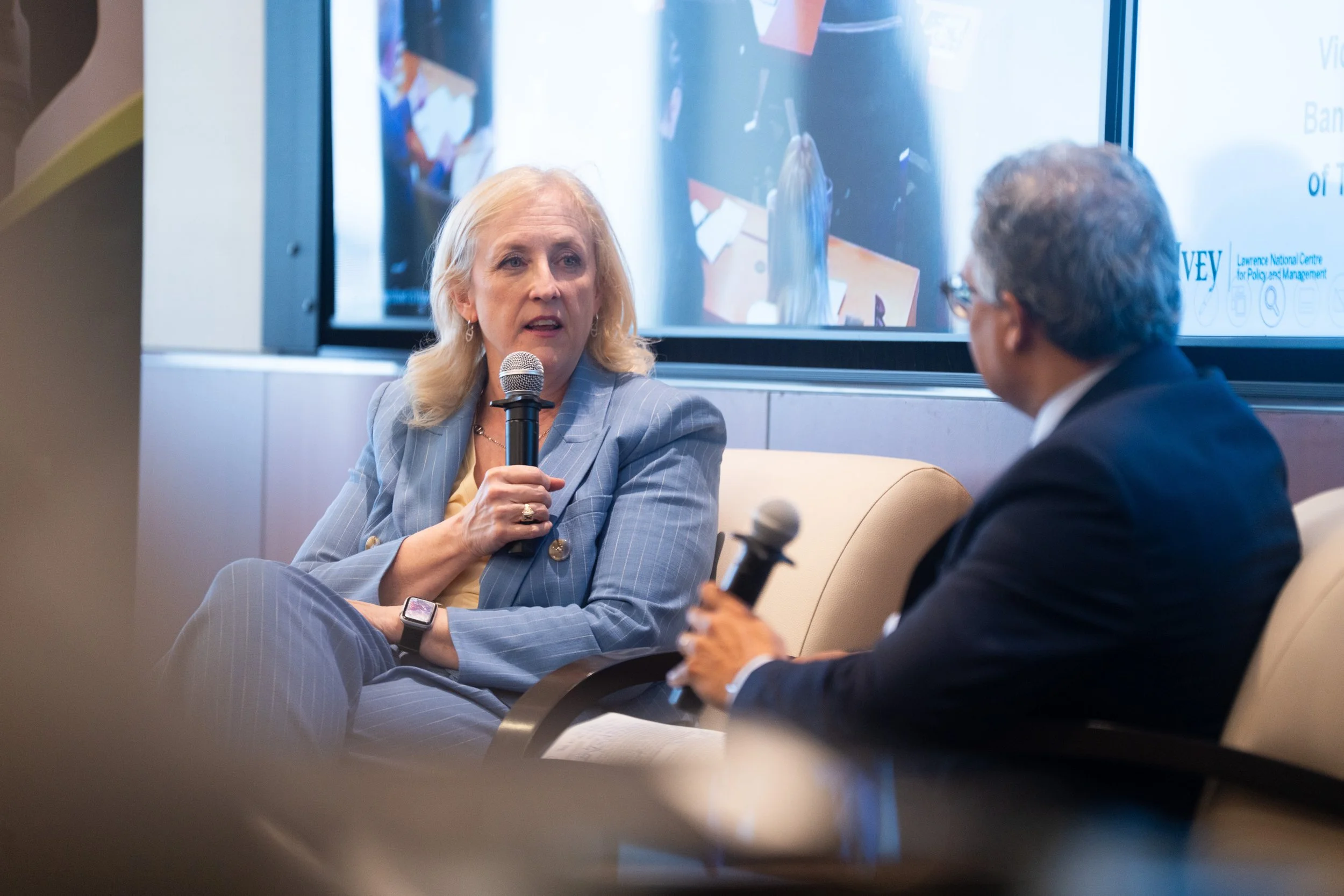
Coalition for a Better Future co-chair Lisa Raitt, at the Lawrence National Centre’s workshop, “Driving Forward: Canada’s Auto Strategy and EV Transition,” speaks with Mahmood Nanji, Ivey’s Power Corporation of Canada Fellow, about the evolving landscape of Canada’s automotive sector. | Photo Credit: Lawrence National Centre for Policy and Management
A viable way forward for Canada’s automotive sector exists despite the current challenges posed by trade shifts and geopolitical instability, said Lisa Raitt, co-chair of the Coalition for a Better Future, who maintains a hopeful outlook for the industry.
Raitt was speaking at a workshop on the future of Canada’s automotive strategy hosted by the Lawrence National Centre for Policy and Management at the Ivey Business School, a Coalition for a Better Future member organization.
Raitt, a former Minister of Natural Resources and current vice-chair in the office of the CEO at CIBC, offered a nuanced take on the sector’s prospects. Referring to Prime Minister Mark Carney’s speech to the Economic Club of New York, she said he's softening in terms of saying we’re going it alone apart from the U.S., he says we want to work with the U.S. in specific sectors, and he “name checks” auto. "I think it looks good for auto. I wouldn't say necessarily it looks good for EVs, because there's not one mention of an EV.”
The "release valve" for North America
In recent discussions with U.S. Ambassador to Canada Pete Hoekstra, Raitt noted that the U.S. administration’s primary concern about autos is with Mexico. “He pointed out to me, he said, we actually look at Canada as the release valve where we can build more autos if we need to build them there.”
She went on to say that this sentiment is underscored by the high degree of integration in the North American supply chain, where 80 to 85 per cent of vehicle content is North American-made. Raitt argues that Canada is well-positioned to remain an essential partner.
Patience, perspective and pragmatism
Mahmood Nanji, Ivey’s Power Corporation of Canada Fellow, who moderated the fireside chat, asked if the Carney government’s auto strategy is right for Canada. Raitt said it’s necessary to have “patience and perspective” when implementing it. “A strategy is only as good as the execution, and the execution can be derailed by challenges that you don't anticipate.”
Drawing on her past portfolio experience in nuclear energy, she noted that sudden, politically driven shifts such as shutting down nuclear initiatives after the Fukushima accident often prove to be missteps when viewed through a long-term lens.
"As much as we wish the EV transition would happen tomorrow, you’ve got to have perspective on how things evolve in our society," Raitt explained. While the EV transition remains a goal, the industry faces stumbling blocks. She suggested that policymakers need to be flexible rather than tied to short-term targets that may ignore the realities of consumer adoption and supply chain readiness.
The call for speed
While Raitt emphasizes the need for patience and perspective on goals, she argues that Canada’s economic survival depends on quickly generating significant revenue. This revenue, she notes, could help navigate potential challenges if U.S. negotiations do not unfold as expected.
Complementing this focus on immediate revenue, she stressed that long-term economic growth must also be inclusive and sustainable to address the affordability crisis affecting Canadians now.
Raitt emphasized that the country cannot "diversify the United States out of our economy," the scale of integration is simply too deep. Instead, Canada must leverage its natural strengths: providing essential resources.
“If we want to be a strong Canada, which we do, then we need to move faster and show progress on building LNG and building oil pipelines and building electricity grids that can go to the United States, feed them,” Raitt said. “We’ve got to do what we do best, which is provide resources, and then try to have value add along the way”
Underscoring the importance of Indigenous consultation in advancing major projects, Raitt highlighted that Indigenous communities, particularly those that have had direct experience with large projects, are increasingly willing to engage as equity partners, as it offers revenue opportunities for their communities.
For Raitt, the bottleneck is not a lack of talent or resources, but a lack of urgency. She urged the federal government to "get out of its own way," saying that public servants must be motivated to stop the "same old, same old" approach. “It's really, start moving and get things going.”

Photo Credit: Lawrence National Centre for Policy and Management