
Investment, trade diversification and co-operation emerge as solutions for long-term prosperity at conference on Canada’s economic future

Marie-Eve Sylvestre, President of the University of Ottawa; Justine Hendricks, President and CEO of Farm Credit Canada; Jeff Nankivell, President and CEO of the Asia Pacific Foundation of Canada; and Kristan Straub, President and CEO of the Canada Indigenous Loan Guarantee Corporation take part in the final panel discussion at the Coalition for a Better Future's Scorecard Reporting Event. The discussion was moderated by Michael Serapio, host of CPAC’s PrimeTime Politics. | PHOTO: Melanie Shields
Canada does not have a resource problem. It does not have a talent problem. It does not have a reputation problem. What Canada has is an execution problem — and the gap between what this country possesses and what it actually delivers was the defining issue at the Coalition for a Better Future's Scorecard Reporting Event, held at the University of Ottawa.
This means coordinating the efforts of educational institutions, businesses and governments to maximize the country’s talent, resources and global reputation.
Across sectors and perspectives, the conversation coalesced around the urgent need to close Canada's investment gap and coordinate the efforts of educational institutions, business and governments to maximize the country’s talent, resources and global reputation.
The closing panel brought together Marie-Eve Sylvestre, President of the University of Ottawa; Justine Hendricks, President and CEO of Farm Credit Canada; Jeff Nankivell, President and CEO of the Asia Pacific Foundation of Canada; and Kristan Straub, President and CEO of the Canada Indigenous Loan Guarantee Corporation. The discussion was moderated by Michael Serapio, host of CPAC’s PrimeTime Politics.
Sylvestre, welcoming attendees to her institution, set the tone with her opening remarks: “Canada has an incredibly strong network of universities, including research intensive universities … But despite all of that, there are still things that we can do to improve those connections with the market and to strengthen Canada's prosperity.”
The investment gap: Canada is falling behind
The Scorecard Report identifies that a lack of investment is causing weak productivity, resulting in falling per capita incomes compared to those of our G7 peers. It argues that “leveraging our natural strengths—especially in agriculture, energy, and critical minerals—while rapidly adopting nascent technologies like AI” is necessary to reclaim Canada’s competitive edge.
Hendricks outlined that Canada's agriculture and food sector accounts for roughly seven per cent of GDP and one in nine jobs nationwide — and yet the country is dramatically underinvesting in the innovation that would unlock the sector’s full potential.
"If we were just able to bring back productivity to two per cent [growth annually] that we once had, we would be able over the next decade to bring in an additional $30 billion to rural communities across Canada," Hendricks told the audience. Looking further out, she projected that enhanced agricultural productivity over 25 years could generate more than $200 billion in economic benefits nationwide.
The barrier, she argued, is investment in agricultural technology in which Canada currently lags the U.S. at a 23-to-1 ratio, Hendricks said. In 2019, total Canadian investment in ag-tech was approximately $270 million.
Straub, acknowledging that Canada has the critical minerals and energy resources sought globally, said that the failure to consult Indigenous communities over the years hampered project development, with some projects being stalled for 15 to 17 years.

“We are building the right ecosystem today to engage Indigenous nations to be able to build projects, attract capital and diversify that wealth that comes from those developments both across Canada, but also with the local rural and Indigenous communities,”
Kristan Straub, President and CEO of the Canada Indigenous Loan Guarantee Corporation.
But empowering Indigenous people to take ownership of major projects, and removing barriers to capital through programs like the Indigenous Loan Guarantee program, “has shifted the discussion from consultation of ‘is this going to happen to me’, versus ‘how do I participate in this?’” said Straub. Of those groups who have done so, the health and education levels in their communities are “head and shoulders above others that have not,” Straub commented.
“While we do need to continue to have discussions about [Indigenous] rights, we also need to have a discussion about economic sovereignty and economic agency with Indigenous populations, and I believe those barriers are being broken down today,” he said.
“We are building the right ecosystem today to engage Indigenous nations to be able to build projects, attract capital and diversify that wealth that comes from those developments both across Canada, but also with the local rural and Indigenous communities.”
Doors are “wide open” for Canada to diversify trading partnerships
As the government has recognized, Canada can profit from diversifying its trade away from the U.S., with particular opportunities in fast-growing countries like India, Nankivell remarked.
“Right now …there is a renewed appetite for what Canada has to offer in the world,” said Nankivell. We need to seize the moment, he said, because, like Canada, other nations are looking to reorient their export-import partnerships in light of the current disruption of traditional global trade patterns.
Two-thirds of global growth in the next few decades will be in Asia, he said, and every year, 10 to 20 million households will cross the threshold into a middle class lifestyle. “That's like the population of Canada being added every year. And they're doing things for the first time. They're urbanizing. They're getting education, different kinds of health care, consumer, all of that.”
“These institutions, these businesses, these governments, they are looking to diversify their relationships. It's not as existential for them as it is for us,” said Nankivell. “We are an attractive partner. So we have a moment in time where the doors are really wide open.”
But several hindrances are blocking Canadian businesses from fully tapping the region's export potential, Nankivell explained.
Canadian companies lack awareness of this potential, coupled with a lack of knowledge about the business and government networks they can draw on to participate in the Asian market. Some firms also lack the agility to adapt products and services they offer or can’t scale up to meet the large demand in the region, he remarked. Plus, Canada’s port infrastructure has to be expanded to handle increased exports.
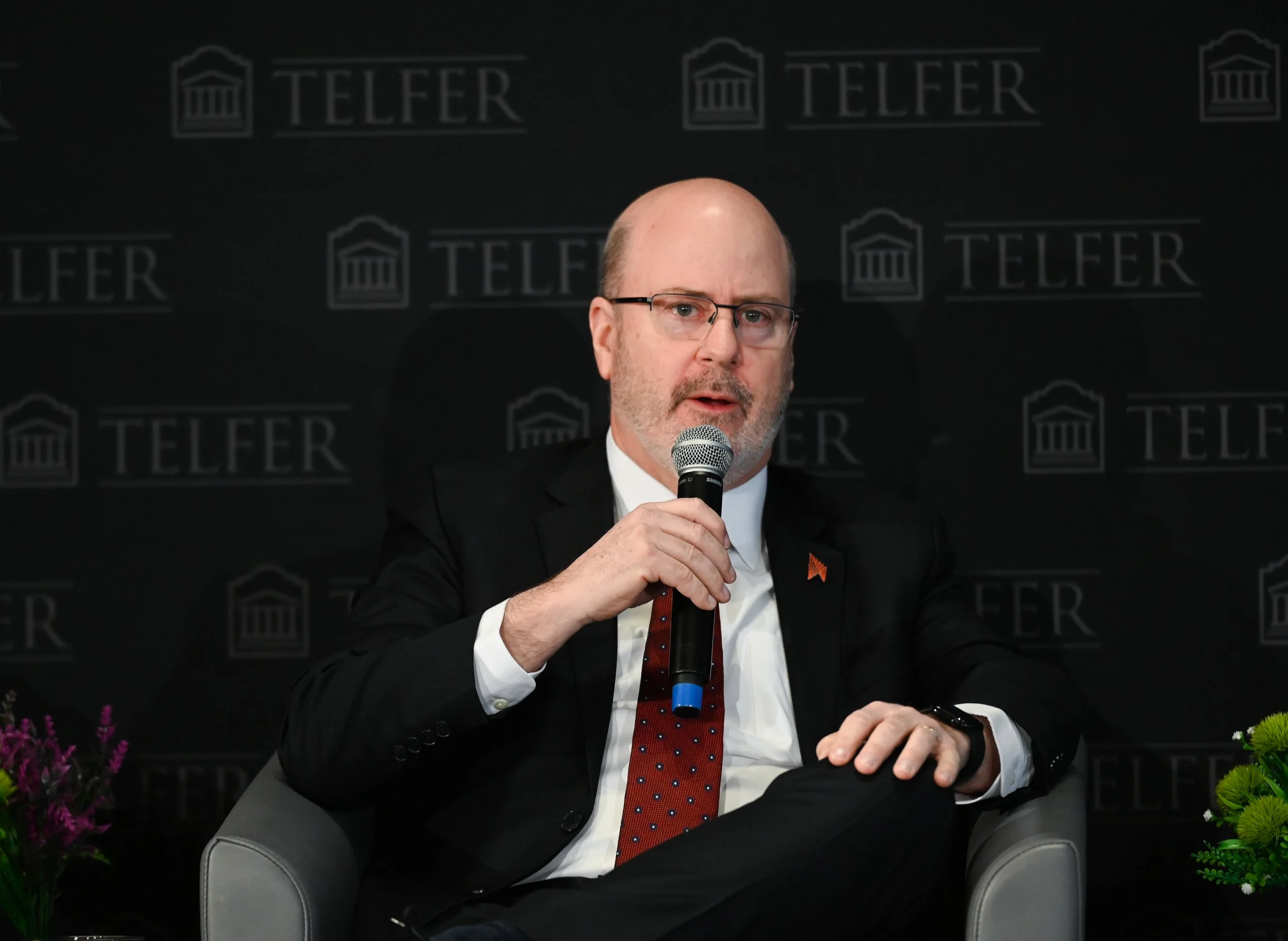
“Right now …there is a renewed appetite for what Canada has to offer in the world.”
Jeff Nankivell, President and CEO of the Asia Pacific Foundation of Canada
Nankivell went on to say that the opportunities are extensive and these markets are not limited to resource and agricultural exports. Services — insurance, pension fund investment, asset management, AI integration consulting, and educational partnerships — represent enormous revenue streams that don’t have the same infrastructure constraints as physical goods. "Let's not focus too much on goods,” Nankivell said. "The opportunities are endless."
Panelists stressed the need to coordinate private-sector, government and university capabilities in the drive to strengthen the economy through expanded exports.
“Universities are experts in scientific diplomacy,” said Sylvestre. She expanded that contacts made abroad through such initiatives like shared laboratories, multi-country programs and international symposiums, are “a great way to build bridges to different countries.”
Hendricks said the key to growing exports is coordination under a Team Canada approach. “How we show up as Canadians and reflect what we understand of those [foreign] markets … becomes so critical so that we can be as efficient” as possible, she said.
Straub noted that Canada has an opportunity now to develop energy sources, including renewable and non- or low-carbon-emitting sources, to export. But to become an energy superpower, we need trade-enabling infrastructure to get the energy, resources and products that we can create into other countries and ensure we do it “sustainably in an inclusive manner,” that works with Indigenous communities.
Coordination, education and training
Reinvigorating the economy’s lacklustre performance will hinge on a national effort to improve training and education, panelists said, with some citing the troubling finding in the Coalition’s Scorecard that 12 per cent of young people are not engaged in employment, education or training.
Straub said industry “needs to do more” when it comes to training, and governments need to work with businesses to encourage more training through tax incentives.
Historically, Straub said, Canada's mining, energy, and manufacturing sectors trained labourers, providing entry-level jobs that enabled immigrants and workers without formal credentials to build successful careers and generational prosperity. “They worked safely, they earned skilled trades, and they had successful careers and good union-paying jobs, and have retired,” he said.
Underscoring the size of the challenge, Sylvestre said, among universities alone, there will be a need for 225,000 STEM and health care-related places for students in the near future.
“We need to increase the funding, we need to increase the spaces for training, and we have to make sure that we think about the different structural barriers that prevent people from going to colleges, institutions and universities,” she continued. Better pathways to education must be found, Sylvestre said.
Also needed are tighter ties between university researchers and industry to support start-ups and help them commercialize, she noted.

“We need to increase the funding, we need to increase the spaces for training, and we have to make sure that we think about the different structural barriers that prevent people from going to colleges, institutions and universities.”
Marie-Eve Sylvestre, President of the University of Ottawa
Agility, execution, coordination: keys to success
As the panel concluded, Hendricks outlined three keys to better growth. She said the first is that Canadians must become more agile in their economic endeavours because “change is the new constant.” Execution is also vital. “We have everything the world wants; our opportunity is to execute, to deliver it,” which requires following through on building infrastructure, more investment in innovation and other pro-growth measures, she said.
And working together to promote growth at all levels is important. Because Canada “is so big, it’s hard to coordinate our efforts,” but this has to change to realize the country’s potential, Hendricks told the audience.
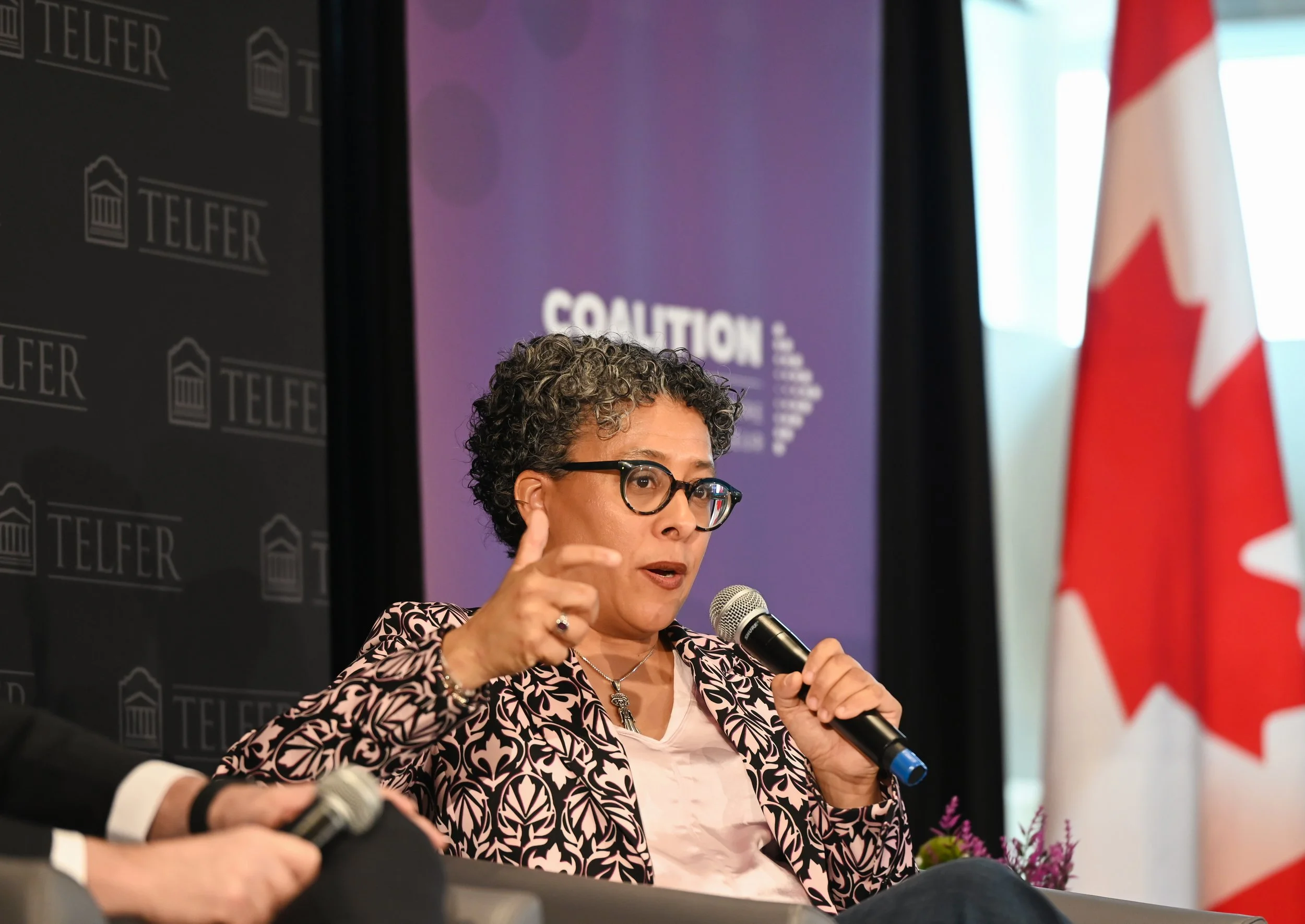
“We have everything the world wants; our opportunity is to execute, to deliver it.”
Justine Hendricks, President and CEO, Farm Credit Canada
Nankivell's closing call was direct: show up, invest the time, and go in person. "You have to go to Asia. You have to go repeatedly. But the upside potential is huge." For students, his message was equally clear: "I have not met a single person who later in life said they regret the time they spent abroad."
Straub returned to reconciliation as his closing thought. Equity ownership for Indigenous Peoples is not only the right thing to do — "It also unlocks capital to be… deployed in a timely manner to enable us to become that economic and energy superpower that we're looking to become.”
And Sylvestre offered a message for the students in the room. "Continue going and chasing your dreams — but know that while you're doing that, you're also contributing to shaping the future of our nation."